
Few people have influenced the knitting world as much as Barbara Walker. Most knitters are familiar with Walker from her indispensable four-volume stitch dictionaries, A Treasury of Knitting Patterns. Walker did much more to further the craft of knitting, though, and she applied her brilliant and curious mind to other subjects as well.

Walker was born in 1930 in Philadelphia. A Phi Beta Kappa graduate of the University of Pennsylvania, she then worked for a Washington, D.C. newspaper while continuing her personal research into comparative religions and mythology — subjects which would fascinate Walker her entire life. Sometimes we assume that experts have been plying their craft since childhood; Walker, however, didn’t learn to knit until her mid-thirties. She explained in an interview that neither her mother nor other female relatives were needlecrafters. After Walker’s marriage, she bought a sewing machine and learned to sew her own clothes, something common for women in the 1950s and 60s. Next she decided to learn how to make herself sweaters. At age 35, then, she taught herself to knit, using a little booklet from Bernat.
In later years, Walker explained that knitting “just happened to be one of my ‘winter studies.’ After marriage, it became my habit to give myself a ‘course’ each year, by collecting all the books in the library on a given subject, and taking notes. In this way I went through astronomy, architecture, paleontology, anthropology, biology, and other matters that I felt curious about.”
Soon, however, the repetitive motion of stockinette stitch seemed “rather boring” to Walker’s active mind. She bought a few knitting magazines and realized that hundred of other patterns existed. We’re spoiled today; in addition to the Walker compilations, we have access to many other stitch dictionaries on-line and in print. This was not true when Barbara Walker started. “The only [stitch pattern] collections I found were those of James Norbury and Mary Thomas, both published in England. So I began making my own collection,” she explained. After a few years, she had collected enough patterns to fill her first Treasury of Knitting Patterns (published in 1968).
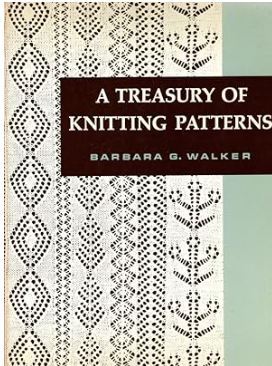
It’s easy to focus on the sheer number of patterns contained in the first Treasury or the variety of techniques included — lace, cables, knit/purl, slip stitch, colorwork, and more. But Walker’s explanations of stitch patterns and their origins were vivid and clear. They offered ideas for variants of the pattern presented. Every pattern was photographed, including the variations and the reverse side of the fabric when both sides were decorative.
After her first Treasury was published, Walker continued to collect patterns and experiment with original patterns of her own design. Two years later, her second Treasury of Knitting Patterns was published. The early 1970s was a prolific time for Walker. She published several books focusing on specific techniques — The Craft of Lace Knitting (1971), The Craft of Cable-Stitch Knitting (1971), and The Craft of Colorwork Knitting (1972). She also began designing for yarn companies and magazines.
In 1972 Walker published the groundbreaking Knitting From The Top Down (KFTTD). It’s not an exaggeration to say that KFTTD was revolutionary, introducing American knitters to the technique of working seamless sweaters from the neckline down. Most knitting patterns in English at this time instructed knitters to make sweaters in pieces that were seamed together later — front, back, two sleeves. Individual pieces were knit from the bottom up — hem to neck for front and back and cuff to shoulder for sleeves. KFTTD showed knitters how to avoid the fiddly process of sewing pieces together (pieces which often end up in a pile for years, if my experience is anything to go by). The technique also allowed knitters to try on their sweater as it was being knit instead of waiting until it was complete and seamed together. Knitters could easily tweak the pattern or accurately measure garment length as they went, allowing for less ripping back.
Two more of Walker’s knitting books deserve special mention. Her Barbara Walker’s Learn-To-Knit Afghan Book was a primer in how to knit: the reader would knit 68 squares that were ultimately assembled into a large afghan or throw. Each block introduced the knitter to a new technique. The first blocks used simple knit-and-purl stitch patterns; subsequent blocks progressed through more advanced techniques like cables and lace. After working through the book, the knitter would have gained a variety of new skills (and an afghan!).
In 1976, Walker published Mosaic Knitting. Walker coined the phrase “mosaic knitting” for a technique in which geometric color patterns were created using slipped stitches, instead of stranded or intarsia colorwork. While slip stitches had been used for a long time, Walker focused on a specific kind of two-color pattern; each row was worked with one color only — no switching colors or stranding — and was a combination of knit stitches and slipped stitches. Walker created and collected hundreds of these patterns, with clear instructions for the knitter. (She included a selection of mosaic stitch patterns in her Second, Third, and Fourth Treasuries, then created over 350 more for Mosaic Knitting.)
I never knew Barbara Walker, but everyone who did discusses her fierce intellect and natural curiosity. Knitter extraordinaire Deborah Newton described her as both “warm” and a “curdmudgeon.” Walker described herself in a 2009 interview: “Basically, I am a scholar. I like doing research. I am always annoyed by people who are too intellectually lazy to do any serious study of subjects in which they claim to be interested.” At some point, Walker’s interests in other subjects began to edge out her fascination with knitting. She had been doing independent research for years and published The Woman’s Encyclopedia of Myths and Secrets in 1983, a reference work discussing mythology, religion, and folklore with a feminist spin. All in all, she published a dozen books focusing on her non-knitting interests, relating to the tarot, the I Ching, matriarchal spirituality, debunking what she called “biblical myths,” crystals, and more.
Barbara Walker will long be remembered for collecting and preserving a wealth of knitting patterns and creating an astonishing number of original stitches — in one interview, she estimated that she invented over a thousand original knitting patterns, “more,” she noted, “than anyone else known to history.” Her clear explanations are still a godsend to new and not-so-new knitters (I remember reading her explanation of how to convert a pattern knit back-and-forth to knit it in the round and thinking, “Yes! Now I get it!”). Her books are timeless and will continue to inspire knitters so long as there are sticks and string. Rest in peace, Ms. Walker. You will be missed.
Photo copyright Sarasota Herald/Tribune
Sources: http://bgw.works/ms_interview.pdf and http://skepchick.org/2009/01/barbara-g-walker-the-skeptical-feminist/

Beautiful tribute, Carol. It really fleshes out the complex and fascinating woman she was. I read once that she personally knit each and every one of her stitch pattern samples. She was a force of nature!