
I first heard the name Heinz Kiewe in the early aughts, when a blogging friend described him as a “knitting crackpot.” Her description intrigued me; while my friend was often dramatic, she knew a hell of a lot about knitting. My initial Google searches turned up contradictory descriptions of Kiewe. Some described him as a textile historian, others as an enthusiast; he authored numerous articles and books, although many received excoriating reviews; he owned a wool shop for over forty years but made nasty comments about his own customers and their tastes.
Kiewe is on my mind today because this month, Piecework Magazine published an article of mine which debunks some of the common myths about Irish sweaters. Kiewe plays a unique role with regard to the aran sweater. I hope you’ll read the article to see how and why.
While there are some good reasons to view Kiewe’s body of work with some skepticism, Kiewe’s life was . .. well. . . complicated. The longer I’m around, the more interested I find myself in individual stories and Heinz Kiewe had a very interesting one.
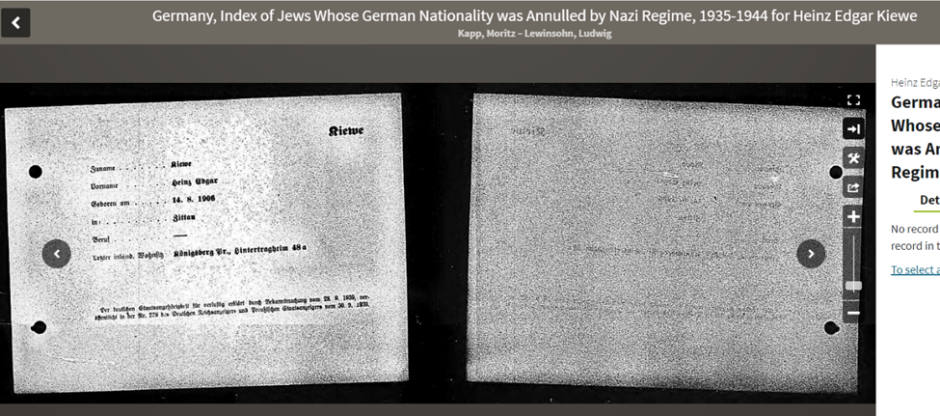
Heinz Edgar Kiewe, born in 1906 in Königsberg, Germany, once said, “Design is in my blood.” Maybe he was right: his father owned a successful department store, and his mother was apprenticed to a Berlin fashion house when she was younger. Kiewe attended a private art school in Berlin, but his family left Germany in the 1930s after the Nazi regime revoked their citizenship simply because they were Jews.
The family arrived in London in 1933, where Kiewe’s father opened a wool/needlework store in Brompton Road that catered to an upscale clientele (including, it was said, Queen Mary).
When war broke out in England, the Kiewe family – even though they were Jews who had fled from persecution in Germany – were considered resident aliens from a hostile power. Heinz Kiewe and his parents were arrested in 1940 and ultimately found themselves in an internment camp on the Isle of Man. Kiewe later described his internment as “one of the best times of my life,” which struck me as odd. When I did a little research about the Isle of Man internees, however, I learned that a large number of artists and thinkers were imprisoned in these internment camps. They took advantage of each other’s talents and knowledge, organizing an on-going series of concerts, lectures, classes and dramatic performances. Many long-lasting friendships were made there.
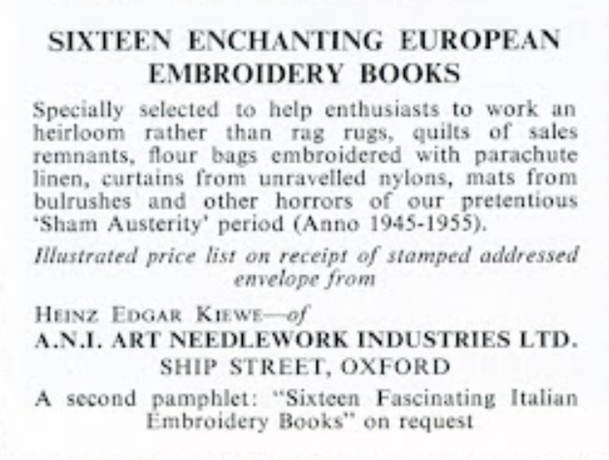
Upon release in 1941, Kiewe re-opened the family textile business, “The Art Needlework Institute,” in Oxford. The shop stocked materials and patterns for embroidery, tapestry, knitting and other fiber arts. The shop thrived, remaining in business for 44 years. During that time, Kiewe began opining about textile history. And geez, did Kiewe love to opine, writing articles on such subjects as cross-stitch, tapestry, textile history, Nigerian sculpture, and more.
Here’s another place where things get a little . . . complicated. Kiewe held himself out as a textile historian, but his qualifications were not so clear. His shop was in Oxford, yet it and he were not officially associated with Oxford University in any way. Kiewe suggested that he sat down with Oxford professors and experts, shooting the breeze about textile history; however, I could find no evidence that his various writings and theories were ever evaluated by Oxford scholars (and in fact, many of his writings drew sharp criticism from textile experts). He did have art school training and his family had run needlework shops for many years, so there was that.
Kiewe is perhaps most known in knitting circles as the author of the book The Sacred Art of Knitting. It’s probably this book that formed my friend’s opinion of Mr. Kiewe — it’s trippy. Many conclusions are drawn but little hard evidence is given and assertions made in the book are just plain wrong. The fanciful tone of the book is quite striking as you can see from this excerpt about aran sweater motifs:
Yes, indeed we confirm them to be ornaments of religion–symbols of the divine “geometrical speculations” of the Near East. What was the importance of the symbol of interlacing? The bond of Man with God and Religion (from re-ligare–to bind “the religious”–person bound by monastic vows, etc.).
The plait? The Holy three stands of hair ribbon or straw, the plaited holy-bread of the Old Testament, they are symbols of a devout family bound up with God.
Do we need now to explain the deep religious meaning of the names of the Aran patterns?
Heinz Kiewe closed his shop in 1985 and passed away the next year, leaving a colorful if not scholarly body of work. Crackpot or curmudgeon, misguided enthusiast or textile historian, market-maker or mythmaker in the handknitting industry? I’ll let you decide. In the meantime, grab a copy of Piecework to learn more about Kiewe’s misguided contribution to the lore of fishermen’s sweaters.
